It has now been two weeks since the United States and Israel began their attacks on Iran, marking the 14th day.
Ayatollah Mojtaba Khamenei, newly appointed as Iran’s Supreme Leader, declared in his first statement that the blockade of the Strait of Hormuz will continue, raising the possibility of a prolonged closure. On the 13th, U.S. President Trump bombed Kharg Island in the Persian Gulf, a military target that handles about 90 percent of Iran’s crude oil exports. The situation in the Middle East continues to deteriorate, and the impact on logistics is immeasurable.
This market update details the escalating Middle East crisis's severe impact on ocean freight. Key points include:
- Widening Conflict and Environmental Risk: The conflict has expanded into the upper Arabian Gulf, with an attack on the tanker *Sonangol Namibe* near Kuwait causing an oil leak, raising fears of an environmental disaster.
- Seafarer Crisis and Ship Attacks: Approximately 20,000 seafarers are reportedly stranded, and at least 12-17 commercial ships have been targeted, since the beginning of the conflict.
- Tanker and Gas Market Disruption: The tanker market is at a "stalemate" with no physical cargo lifted, and rates are largely academic. Qatar's force majeure on gas exports (20% of global LNG supply) has caused LNG spot rates to surge tenfold to over $300,000 per day.
- Port Congestion: Several ports in the region are congested. Carriers are diverting containers to nearby ports of Sohar, Karachi and Mundra.
- Fuel Surcharges: As crude oil prices reached $110 on Monday, March 9, ocean carriers announced $ 400-$ 450 emergency fuel surcharge for all trade lanes.
- Container Shipping Delays and Diversions: Asia-Europe flow arrival delays have increased significantly (e.g., HMM's delays jumped from 3.72 to 10.45 days). Many carriers are now opting for the longer Cape of Good Hope route to avoid the conflict zone.
- Prohibitive Costs and Insurance: The cost of insuring a ship through the Strait of Hormuz has soared 12-fold, with premiums now as high as 3% of a vessel's value. Shippers are warned that traditional cargo insurance does not cover delays.
- Stranded Cargo: Ocean carriers like Maersk, CMA CGM, and Hapag Lloyd have suspended cargo bookings to Gulf ports, leaving over 270,000 TEUs of cargo stranded. This will likely lead to empty container shortages in Asia in the coming weeks
- Market Trends: Global container shipping rates are rising following the Lunar New Year as Asian factories reopen, but the Hormuz crisis threatens to inject new volatility due to rising bunker fuel costs, war-risk premiums, and operational disruptions.
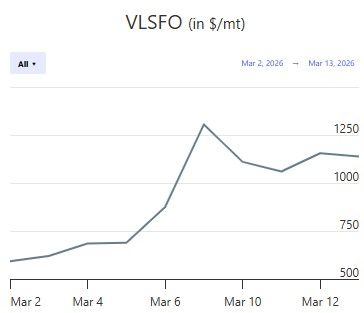
- Singapore’s VLSFO (Very Low Sulfur Fuel Oil) Trends: Experienced significant price fluctuations in early March, with the latest surge bringing it to around USD 945 per metric ton. Supply remains tight, and prices have swung dramatically from the USD 600 range to over USD 1,100 within a short period, reflecting a highly unstable market. Rising crude oil prices and heightened tensions in the Middle East are the primary drivers of this increase. (Source)