


The preliminary U.S.–Iran agreement signed by President Trump is framed as a memorandum of understanding to end the war and reopen the Strait of Hormuz, a vital shipping lane for oil, gas, and fertilizer.
Singapore’s VLSFO (Very Low Sulfur Fuel Oil) bunker prices have been trending downward in June 2026. Here’s the latest snapshot from Ship & Bunker.
- Prices have fallen from nearly $800/mt on June 8 to around $669.5/mt by June 19.
- The decline reflects weaker demand and easing crude benchmarks.
- Forecasts suggest further softening: Q3 2026 average projected at $749/mt, dropping to $673/mt in Q4 2026
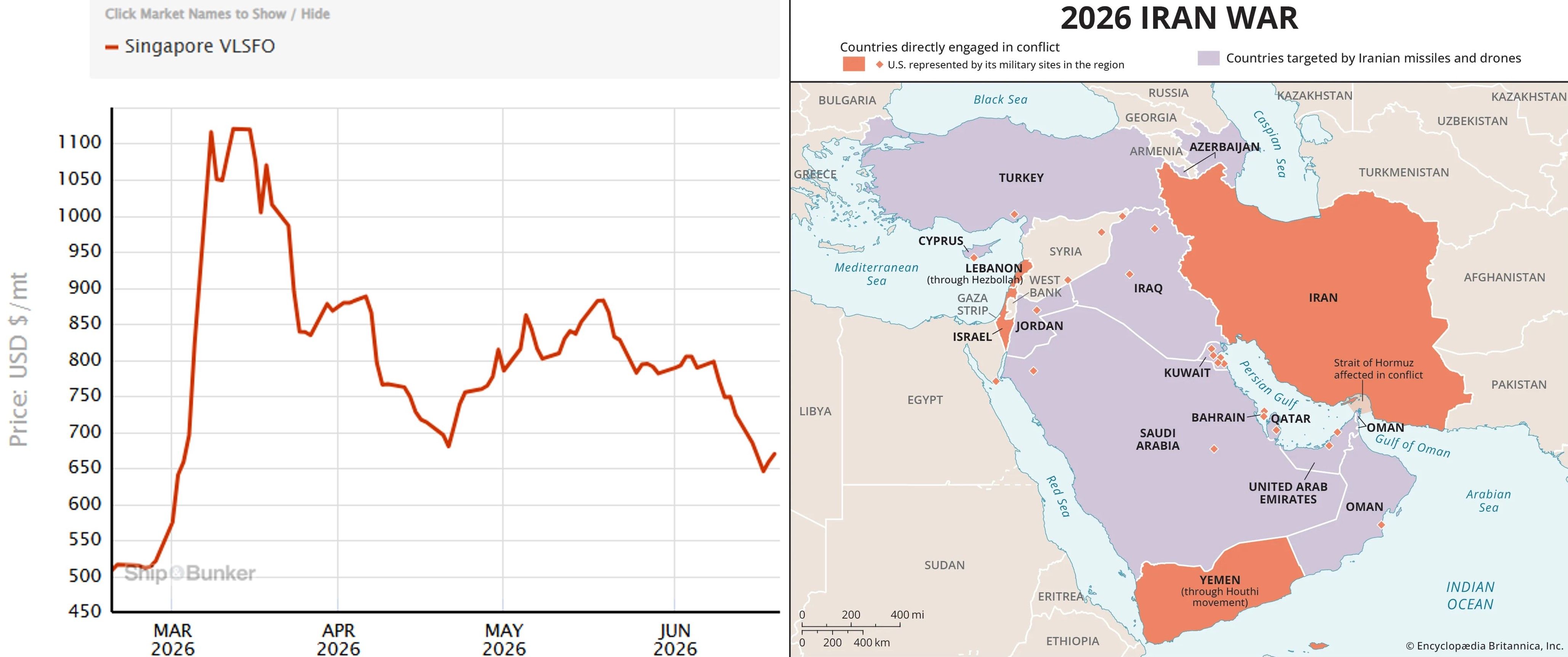
Supply Chain Impact, shipping costs: Lower bunker fuel prices reduce operating costs for carriers. Also freight rates could ease slightly if fuel remains cheaper, though demand dynamics also matter. Margins are beneficial for shipowners, especially those operating on tight margins.
Here are the key supply chain impacts highlighted in the reporting:
Global Trade & Energy
- Strait of Hormuz reopening: This waterway is critical for global energy flows. Its reopening means oil and gas shipments can resume, stabilizing supply chains that had been disrupted during the conflict.
- Naval blockade lifted: The U.S. ended its blockade of Iranian ports, allowing ships to move freely again. This reduces bottlenecks for commodities like crude oil, petrochemicals, and fertilizers.
Economic & Financial Effects
- Sanction waivers: The U.S. plans to issue waivers so Iran can immediately sell oil. This increases global supply, potentially lowering energy costs and easing inflationary pressures.
- Unfreezing assets: Tens of billions of dollars in Iranian funds may be released, boosting Iran’s ability to trade internationally and invest in infrastructure.
Shipping & Logistics
- Persian Gulf Strait Authority: Iran will require ships to request permission to pass, adding a new layer of regulation. While traffic resumes, companies must adapt to new compliance procedures.
- Insurance & risk premiums: Even with the agreement, uncertainty remains. Shipping companies may face higher insurance costs until stability is proven.
Risks & Fragility
- 60-day window: The deal is temporary, with a 60-day period for further negotiations. Supply chains could face renewed disruption if talks collapse.
- Israel’s defiance: Israel has rejected the agreement and continues military operations in Lebanon, which could destabilize regional trade routes.
Its immediate impact is the resumption of global energy flows, as the U.S. lifted its naval blockade of Iranian ports, reducing bottlenecks for crude oil and petrochemicals. Sanction waivers will allow Iran to sell oil quickly, boosting supply and potentially lowering energy costs, while the unfreezing of billions in assets strengthens Iran’s trade capacity.
For shipping and logistics, the deal introduces a new compliance requirement: vessels must seek permission from Iran’s Persian Gulf Strait Authority to pass. Although traffic resumes, insurers may keep premiums elevated until stability is proven. The agreement is fragile, with only a 60‑day window for further negotiations, meaning supply chains could face renewed disruption if talks collapse. Israel’s rejection of the deal and ongoing military operations in Lebanon add further uncertainty.