



Japan was the number 3 economy in the world in terms of GDP (as of 2022), the number 4 in total exports, the number 4 in total imports, the number 32 economy in terms of GDP per capita (current US$) and the number 1 most complex economy according to the Economic Complexity Index (ECI) .
TRADE EXPORTS
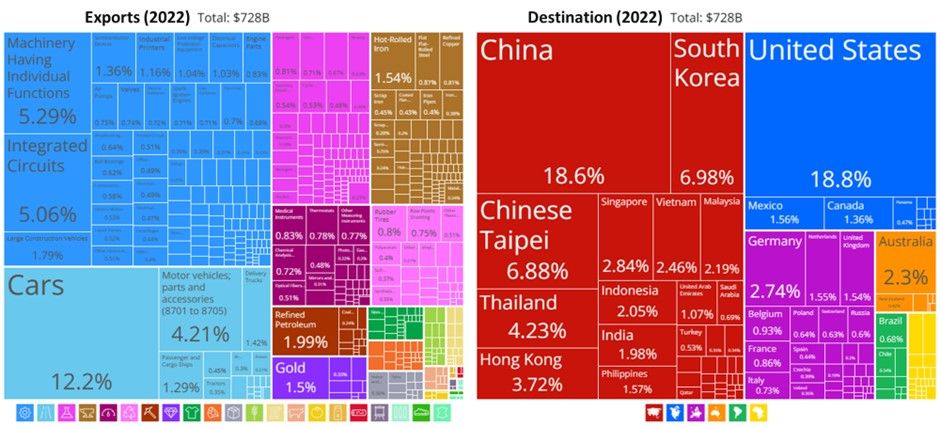
The top exports of Japan are Cars ($89B), Machinery Having Individual Functions ($38.5B), Integrated Circuits ($36.9B), Motor vehicles; parts and accessories (8701 to 8705) ($30.6B), and Refined Petroleum ($14.5B), exporting mostly to United States ($137B), China ($135B), South Korea ($50.8B), Chinese Taipei ($50.1B), and Thailand ($30.8B). In 2022, Japan was the world's biggest exporter of Machinery Having Individual Functions ($38.5B), Hot-Rolled Iron ($11.2B), Flat Flat-Rolled Steel ($6.3B), Thermostats ($5.66B), and Photographic Chemicals ($3.47B)
Source: OEC
TRADE IMPORTS
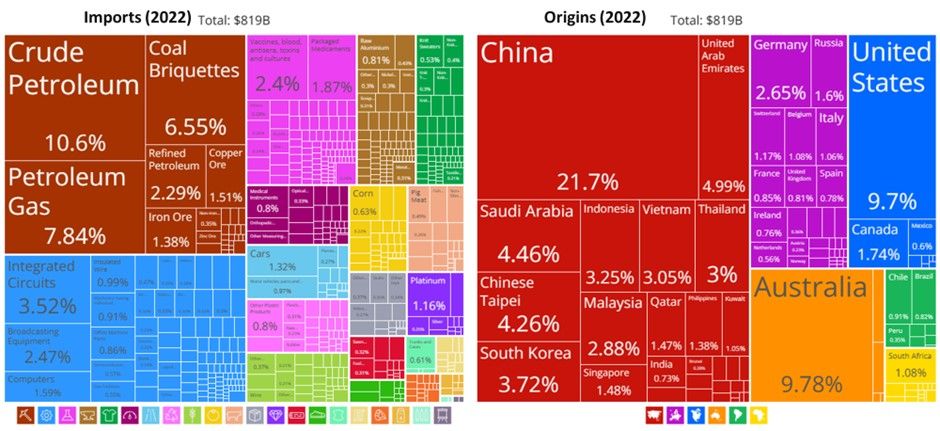
The top imports of Japan are Crude Petroleum ($86.7B), Petroleum Gas ($64.2B), Coal Briquettes ($53.7B), Integrated Circuits ($28.9B), and Broadcasting Equipment ($20.3B), importing mostly from China ($178B), Australia ($80.1B), United States ($79.5B), United Arab Emirates ($40.9B), and Saudi Arabia ($36.5B). In 2022, Japan was the world's biggest importer of Other Prepared Meat ($3.02B), Ethers ($2.28B), Processed Tobacco ($1.75B), Sulfates ($860M), and Alkaline Metals ($679M)
Source: OEC
Rising demand for road freight services witnessed owing to increasing ecommerce sales and structural changes in Japan
- The surge in imports and exports of goods and materials worldwide is expected to drive the Japanese road freight transport market during the forecast period. Japan's road freight industry is undergoing rapid development and structural changes to meet the growing demand. Over 90% of truck carriers are small- and medium-sized enterprises (SMEs). Because of the growing demand for e-commerce sites, the number of mini cars and vans used for cargo transportation is expected to increase soon. Despite increasing cash income and a growing labor force, as drivers age rapidly, the supply of labor needed to maintain e-commerce and the overall low-price domestic market is still under threat.
- Japan's e-commerce transportation industry pattern is dominated by three expansion organizations, which control more than 90% of the domestic parcel delivery market. The largest transporter, Yamato Transport Company, delivers more than 1.8 billion packages each year. Close competitor Sagawa Express provides logistics services to major customers, including Amazon. Japan Post is the third-largest player.
GROWTH OF THE JAPANESE ECOMMERCE MARKET
The growth of Japanese ecommerce and the increasing demand for shipping services is a huge driver of growth for the logistics industry in Japan. As well as high personal wealth, the nation’s developed economy and the fact that most people live in highly urbanised areas, this is a great market for ecommerce retailers.
Major B2C platforms like Amazon and Rakuten have consistently increased annual sales in Japan, but we’ve also seen a growth of C2C platforms like Mercari take off — providing another way for consumers to shop and an increased need for smart delivery solutions in a market where consumer expectations for fast and reliable deliveries is extremely high.
We’ve also seen larger numbers of older demographics take up online shopping since the pandemic, contributing to sales in product categories such as healthcare, medical equipment, and groceries.
Logistics 2024 Problem
With revisions to laws being carried out since 2019 to implement working style reforms, as of April 2024 truck drivers will be limited to a maximum of 960 overtime hours per year. While this cap on overtime will improve the labor situation for individual truck drivers by decreasing how far they have to drive at once, there are concerns that it will no longer be possible to transport goods in a timely fashion over long distances, that drivers might switch to different industries due to lower overall income, or that sales will decrease for the logistics industry. This is referred to as the “logistics 2024 problem” in Japan, and the government’s study group on sustainable logistics estimated that if nothing is done, then there will be a 14% shortage of truck transportation capacity in 2024, and a 34% shortage in 2030. Japan’s logistics industry, which relies on drivers working long hours, urgently needs to take action.
Source: Mr. Masaru Hojo, Director General Manager JILS Research Center