

The logistics industry in Indonesia is currently heavily dominated by foreign companies, a fact highlighted by data from the Indonesian Digital Economic Logistics Association (ALDEI).
ALDEI’s data reveals that several large companies, mostly owned by foreign entities, now command approximately 70% of the market share, while domestic players control the remaining 30%.
Manorsa P. Tambunan, the Secretary of ALDEI, has voiced concerns over this dominance and its implications for Indonesia’s logistics landscape. One of the key issues is the unhealthy competition fostered by foreign investors, who possess significantly larger capital reserves, leading to price wars.
“This significant shift includes the increasing dominance of foreign players, who are aggressively seizing market share and altering the market structure into an oligopsony, where logistics partnerships are no longer determined by the preferences of service users (online buyers) but are regulated by e-commerce platforms,” stated Tambunan.
Predatory pricing practices
Tambunan also highlighted that in recent years, the price competition within the courier industry has indicated signs of predatory pricing, where major players employ massive investment strategies to build service capacities and set selling prices below production costs, aiming to capture market share and harm domestic competitors.
“There are two types of prices in this industry, gross prices (published rates) and net prices (discount prices between sellers and buyers),” he explained.
“The lack of monitoring mechanisms for net prices, which should comply with Regulation No. 1 of 2012 from the Ministry of Communication and Information Technology, prohibiting the sale of goods below production costs, hampers the implementation of this regulation,” he continued.
Tambunan stressed that predatory pricing has a detrimental impact on couriers, often resulting in lower wages for delivery personnel as courier companies transition from permanent employees to partners.
In light of these challenges, Tambunan emphasized the need for equal opportunities in the logistics industry. In this regard, the government, as the regulator, plays a pivotal role in maintaining a fair business environment in Indonesia and preventing excessive price wars while safeguarding all stakeholders, including entrepreneurs, consumers, and industry workers.
ALDEI hopes that the government, through relevant ministries, will take stricter measures, including implementing sanctions, to protect the future aspects of the logistics industry and provide opportunities for domestic players to compete fairly.
Predatory pricing in e-commerce
The Business Competition Supervisory Commission (KPPU) also responded to a request from the Minister of Cooperatives and SMEs, Teten Masduki, to proactively investigate predatory pricing on TikTok Shop.
Regarding TikTok’s plans to ban links to other e-commerce platforms, the KPPU is studying this matter. Teten Masduki expressed concerns about TikTok’s social commerce operations and the need for clear regulations to ensure the survival of other industries in Indonesia.
Just for your information:
- Transaction value in the Digital Commerce market is projected to reach US$95.32bn in 2024.
- Transaction value is expected to show an annual growth rate (CAGR 2024-2028) of 9.53% resulting in a projected total amount of US$137.20bn by 2028.
- In the Digital Commerce market, the number of users is expected to amount to 204.90m users by 2028.
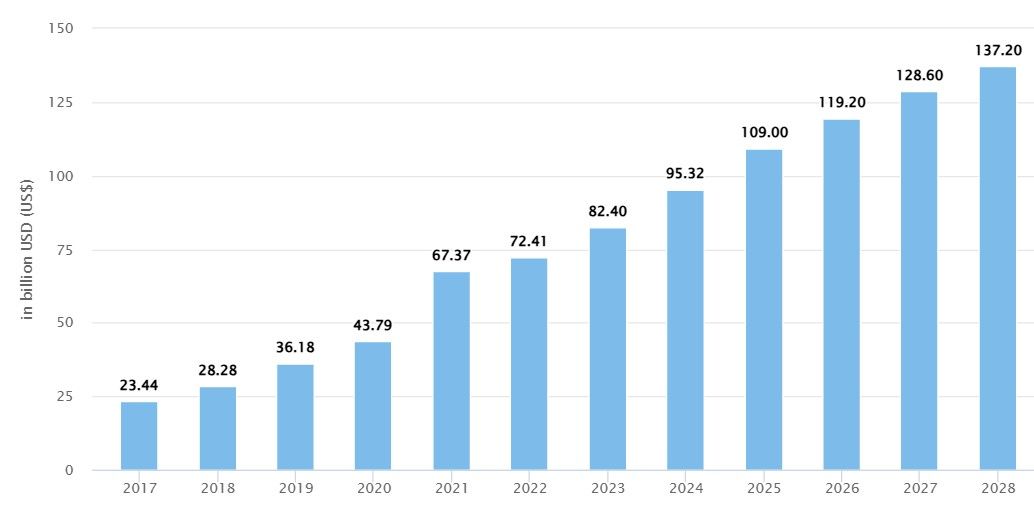
Source: Statista Market Insights - March 2024