



Taiwan Semiconductor Manufacturing Company (TSMC) announced that quarterly revenue increased 17% in the first quarter of 2024, exceeding analysts' expectations. The reported boom continues a trend in better-than-expected sales, signaling that the end of the global slump in the chip market may be in reach.
Though many anticipate chip inventory rebalancing and normalization come early 2025, the chip supply chain will continue to face challenges and constraints. Infrastructure costs, geopolitical events, increased vulnerability to natural disasters, and both natural resource and talent shortages will all contribute to ongoing challenges, even as semiconductor supply normalizes.
The widespread adoption of artificial intelligence (AI) and hyper-scale cloud computing is driving much of the surge in chip demand and has also led to shifting fabrication plant (fab) priorities, which will impact sourcing for certain components in 2025 and beyond.
Though some elements of market recovery are worth celebrating, buyers should remain cautious and proactively prepare for recovery while developing strategies that help minimize risk.
Factors Driving Market Normalization
The semiconductor market should ease into more balanced, predictable supply behavior in early 2025. This will be due to the following factors:
- “Take or Pay” contractual agreements terminating
- Better supply visibility by early 2025
- Surety of product manufacturing
- An improved economic situation, with better capital flow and moderating interest rates
- Semiconductor market growth opportunities related to AI hyper-scaling and high-end cloud computing demand
In 2025 and beyond, the AI, cloud and embedded space is expected to have above-average growth driven by high underlying demand for edge computing, data centers, networking and infrastructure equipment, and the continued proliferation of IoT products. Top semiconductor manufacturers, including TSMC, have seen a consistent increase in demand for semiconductors due to the boom in demand for AI products specifically. The demand in this space will continue — and likely grow — for the next several years at a minimum.
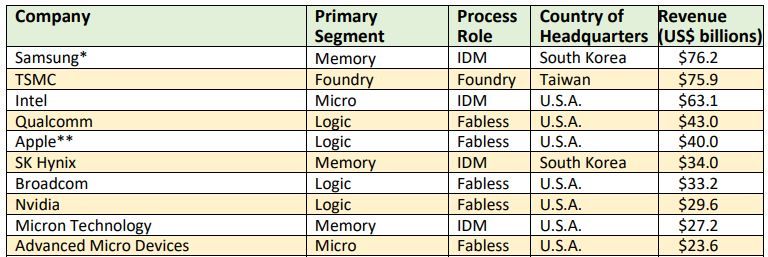
World’s 30 Largest Semiconductor Companies by Revenue: 2022
Source: Office of Technology Evaluation, Bureau of Industry and Security, U.S. Department of Commerce, “Assessment of the Status of the Microelectronics Industrial Base in the United States,” December 2023, p. 15