


US President Donald Trump’s landmark visit to China comes as the US-Iran war disrupts global energy supplies, fuels economic uncertainty and adds fresh strain to Washington-Beijing ties. In the latest instalment of a series examining how rivalry, interdependence and geopolitical crises are reshaping the relationship between the two powers, we explore the massive upswing in capital expenditures across Asia that is driving a broad shift in economic power.
When US President Donald Trump made his state visit to Beijing this week, he brought one of the wealthiest business delegations ever to call from the United States.
But while the executives joined Trump in search of further opportunity in Asia’s largest market, any capital they would contribute for a deal would end up recirculating around China and the continent at large, inadvertently providing more fuel for a massive reorientation of economic activity already in progress.
The late addition of Huang to the group is noteworthy as Nvidia's advanced artificial intelligence (AI) chips are a major focus of the rivalry between the US and China. Huang also serves on Trump's Council of Advisors on Science and Technology, alongside other business leaders including Meta's Mark Zuckerberg and Oracle boss Larry Ellison.
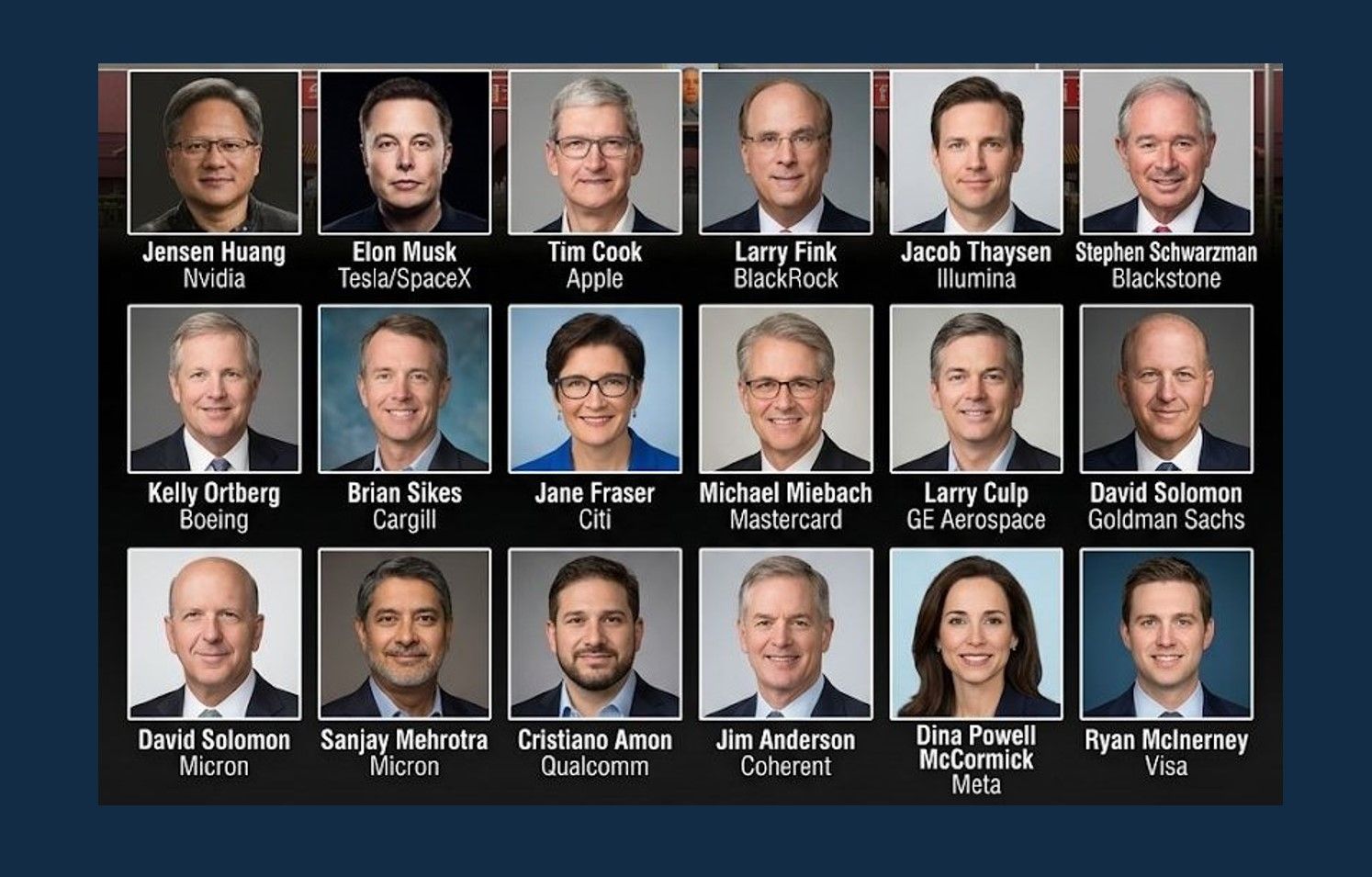
The full list of the executives joining Trump as part of the official US delegation to China is as follows:
- Elon Musk – CEO, Tesla and SpaceX
- Tim Cook – CEO, Apple
- Jensen Huang – CEO, Nvidia
- Larry Fink – Chairman and CEO, BlackRock
- Stephen Schwarzman – Chairman, CEO and co-founder, Blackstone Inc.
- Kelly Ortberg – President and CEO, Boeing
- Cristiano Amon – President and CEO, Qualcomm
- Sanjay Mehrotra – Chairman, President and CEO, Micron Technology
- Jane Fraser – Chairman and CEO, Citigroup
- David Solomon – Chairman and CEO, Goldman Sachs
- Brian Sikes – Chairman and CEO, Cargill
- Dina Powell McCormick – President and Vice Chair, Meta Platforms
- H. Lawrence Culp Jr. – Chairman and CEO, GE Aerospace
- Ryan McInerney – CEO, Visa
- Michael Miebach – CEO, Mastercard
- Jacob Thaysen – CEO, Illumina
- Jim Anderson – CEO, Coherent Corp
With electric vehicles, AI and semiconductors becoming key battlegrounds in the US-China rivalry, both Tesla and Nvidia are very exposed to China.
Tesla relies heavily on its Shanghai gigafactory and Chinese consumers, while Nvidia wants to be able to start selling advanced chips to China again, which is currently prohibited by US export controls.
US export controls are aimed at limiting China's access to frontier AI capabilities, but Greer said they were not a major talking point at the summit. Beijing, however, continues to push for greater access to advanced tech, while criticising what it sees as efforts to constrain its industrial development.
AI was expected to be a big part of conversations. "We talked about possibly working together for guardrails", Trump told reporters. When asked about what kind of guardrails, he added: "Standard guardrails that we talk about all the time." While China is a major market for US companies, it is also a difficult operating environment because of regulation, red tape and geopolitical uncertainty.
But Beijing seemed to strike a positive note on this issue. Xi told US business leaders that China's "doors will open wider" and that American firms would have "broader prospects" in the Chinese market, according to news site Xinhua.
He also called for expanded co-operation in trade, agriculture, healthcare, tourism and law enforcement, describing bilateral ties as "mutually beneficial" and delivering "win-win results".