


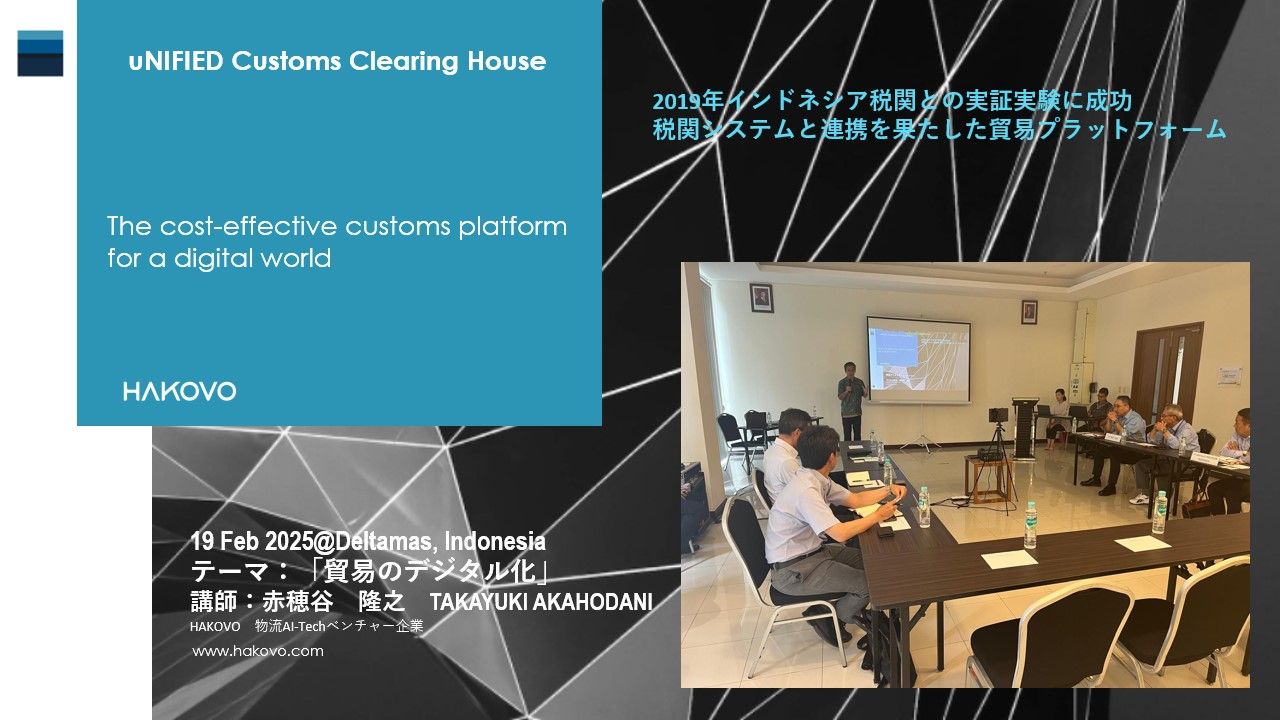
On February 19, 2025, the GIIC Deltamas Industrial Park hosted a Japanese information exchange meeting. Targeting companies within Deltamas, HAKOVO presented during the seminar part. The speaker was Takayuki Akahodani, the Founder & CEO of HAKOVO, who has 33 years of experience in IT and the supply chain & logistics industry. Both online and offline, discussions were held on the following themes:
Unleashing the Future of Trade:
- Are the barriers to trade digitalization too high?
- How can we improve operations towards digitalization?
- How do we identify challenges?
- Is digitalization possible at zero initial cost?
- What are the steps to start digitalization now?
Is the Barrier to Trade Digitalization High?
For a long time, trade operations have fundamentally relied on "paper trade documents and their originality." Examples include Bills of Lading (B/L), Letters of Credit (L/C), and Certificates of Origin (C/O). These trade documents are mainly circulated "by hand or mail" among many stakeholders responsible for trade operations, including exporters, importers, freight forwarders, customs brokers, shipping companies, transport warehouses, insurance companies, and banks. Additionally, the need for offices or warehouses to store paper documents acts as a major constraint to efficiency in terms of time, location, cost, and operational accuracy. However, regarding C/O, from 2021 within the ASEAN region and from 2023 under the Japan-Indonesia EPA, data exchange for C/O has started to be conducted between issuing organizations and customs authorities of the receiving countries. Digitalization at the intergovernmental level is very challenging. However, is digitalization, including data exchange at the level of exporters, importers, and forwarders, difficult? Certainly not.
Methods and Ways to Identify Challenges for Improving Operations Towards Digitalization?
First, to lower the barriers, it is important to improve operations towards digitalization and identify challenges. Where are the bottlenecks within the operations? In the business process:
- Identify actions/time that produce value and generate profit as Value Added (VA)
- Identify actions/time that are wasteful and do not create value or generate profit as Non-Value Added (NVA)
There are various reasons why NVA exists, including "working environment," "regulations," "customs," "emotions," "corporate culture," and "habits." NVA includes decision-making time, waiting time, and rework time. These are extra costs for areas that do not produce value or profit. Are these activities truly necessary? This is the bottleneck.
Steps to Start Digitalization Now?
There are only two steps to start trade digitalization. By taking these two steps, "explosive improvement in operational efficiency and cost reduction" can be achieved.
Step 1: Convert trade data to digital data without changing the existing process. This is "digitization," such as converting paper documents into electronic data. For example, digitize your trade documents like commercial invoices and packing lists.
Step 2: Upload the digitized information to the cloud, "cloud computing of operations." That's it. By managing it on the cloud, transitioning to automation, and sharing data, NVA can be reduced. At the same time, it also strengthens BCP. BCP is the Business Continuity Plan, an important plan that companies should prepare for emergencies that may occur at any time.
HAKOVO's digital solution achieves digitalization and cloud computing of operations at zero initial cost. HAKOVO's digital products provide solutions that dramatically improve productivity by eliminating waste in your logistics operations. We promise significant reduction in logistics and operational costs, time savings, and improved compliance.
GIIC Industrial Park (Greenland International Industrial Center) : Located in Bekasi Regency, West Java, Indonesia, this vast industrial park is within Deltamas City, with a total development area of approximately 3,200 hectares, of which about 2,200 hectares are developed as the industrial area. This project is jointly promoted by Sojitz Corporation and the Sinar Mas Group, one of Indonesia's largest Chinese conglomerates. In GIIC Industrial Park, in addition to land sales, they also propose rental factories and provide key infrastructure development, operation, and maintenance services, including water supply, drainage, roads, and logistics services.
Additionally, many Japanese companies have advanced into GIIC Industrial Park, and various infrastructures and services to support businesses are well-prepared. For example, they provide stable infrastructure with a water supply capacity of 24,700㎥/day, a treatment capacity of 12,400㎥/day, and a premium service contract with PLN (State Electricity Company) for prioritized supply.